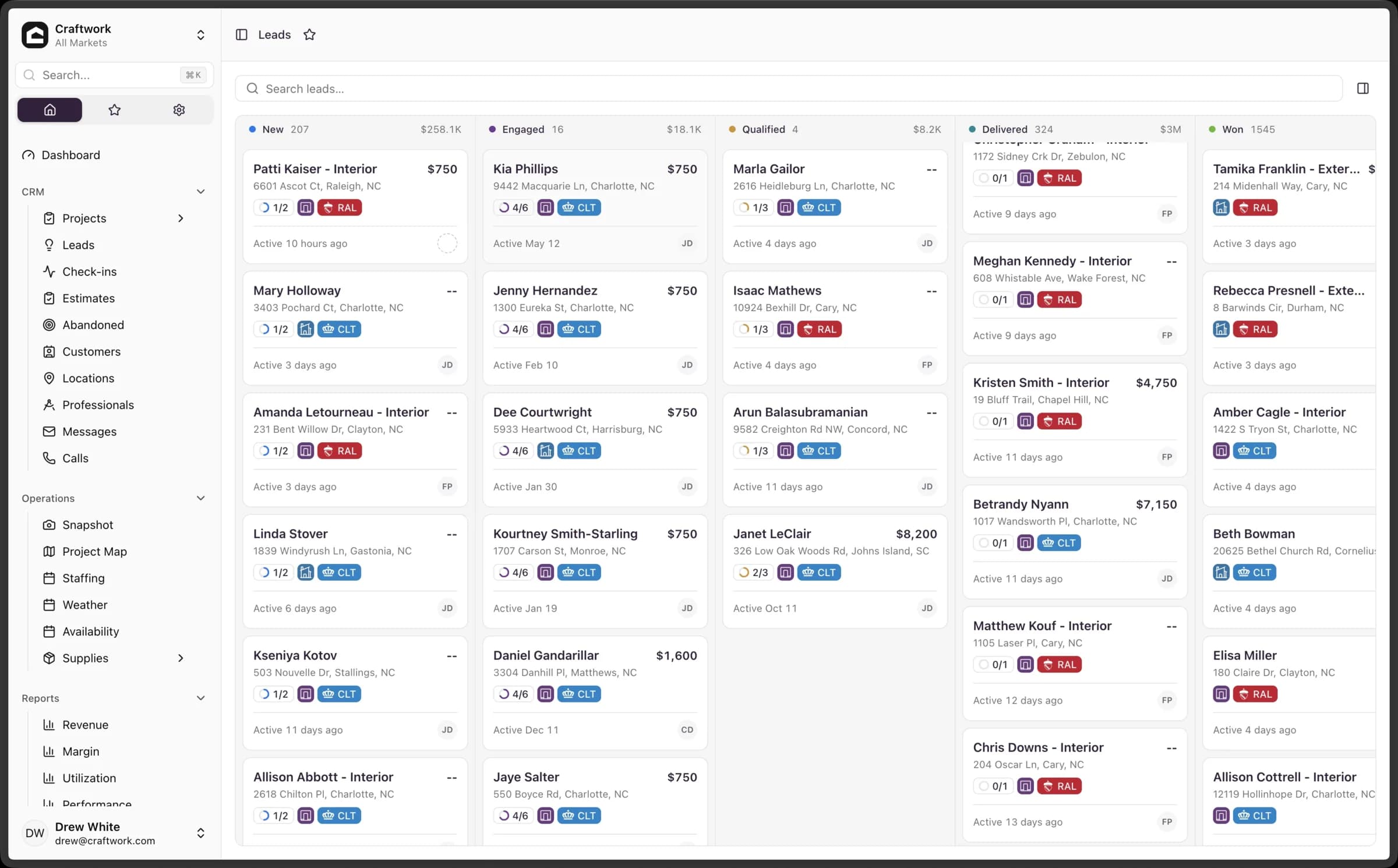
Lead Pipeline and CRM
The full lead-to-customer pipeline for a residential services company: kanban-style board, full-context lead surface, two-way conversation hub, first-class tasks, and source-attributed funnel reporting in one place.
Context
Craftwork generates leads from paid ads, organic search, and referrals across three markets. The sales team needed one place to see every lead, its stage, the conversations attached to it, and where revenue was leaking.
Challenge
Leads came in from multiple sources and landed in different tools. The team could not see which leads were hot, which were stale, and which had already been contacted. Stage-to-stage conversion was invisible at the source level, so the gaps that cost the most revenue were the hardest ones to act on.
Decisions
- Designed the pipeline as a kanban-style board with stages mirroring the actual sales process (New → Engaged → Qualified → Delivered → Outcome), card density tuned so an operator can scan 250+ leads without losing the picture.
- Built the lead detail surface as Activity / Tasks / Audits in one workspace, with verbatim call and meeting logs, property metadata, photos, and a colored stage-progress bar at the top so the operator always knows where the lead is.
- Added per-stage requirement gates (e.g., 'Deposit Collected' before a Delivered lead can close) so the system enforces what the playbook says without forcing the operator to remember it.
- Made tasks first-class. Typed (Check-in, Follow-up, Call), with priority, due date, and assignee, attached to the lead they belong to so nothing stalls between stages while the operator is working another card.
- Wired a two-way conversation hub into the CRM. Every inbound text, outbound rep message, and referral-campaign send sits on the lead, so the team works one record instead of jumping between phones, inboxes, and message tools.
- Built the Estimate Pipeline report with source attribution (Paid / Organic / Internal), so the team sees stage-to-stage conversion broken out by lead source and acts on the gap that costs the most revenue.
Result
The pipeline tracks every lead source in one place, and the sales team works from a single board instead of jumping between tools. Source attribution surfaced bottlenecks that were not visible before, so the team acts on the gap that costs the most revenue same-day, not next quarter. The funnel converts roughly 16% of estimate requests into customers, about $600K in converted estimate value over a recent three-month window across three markets.