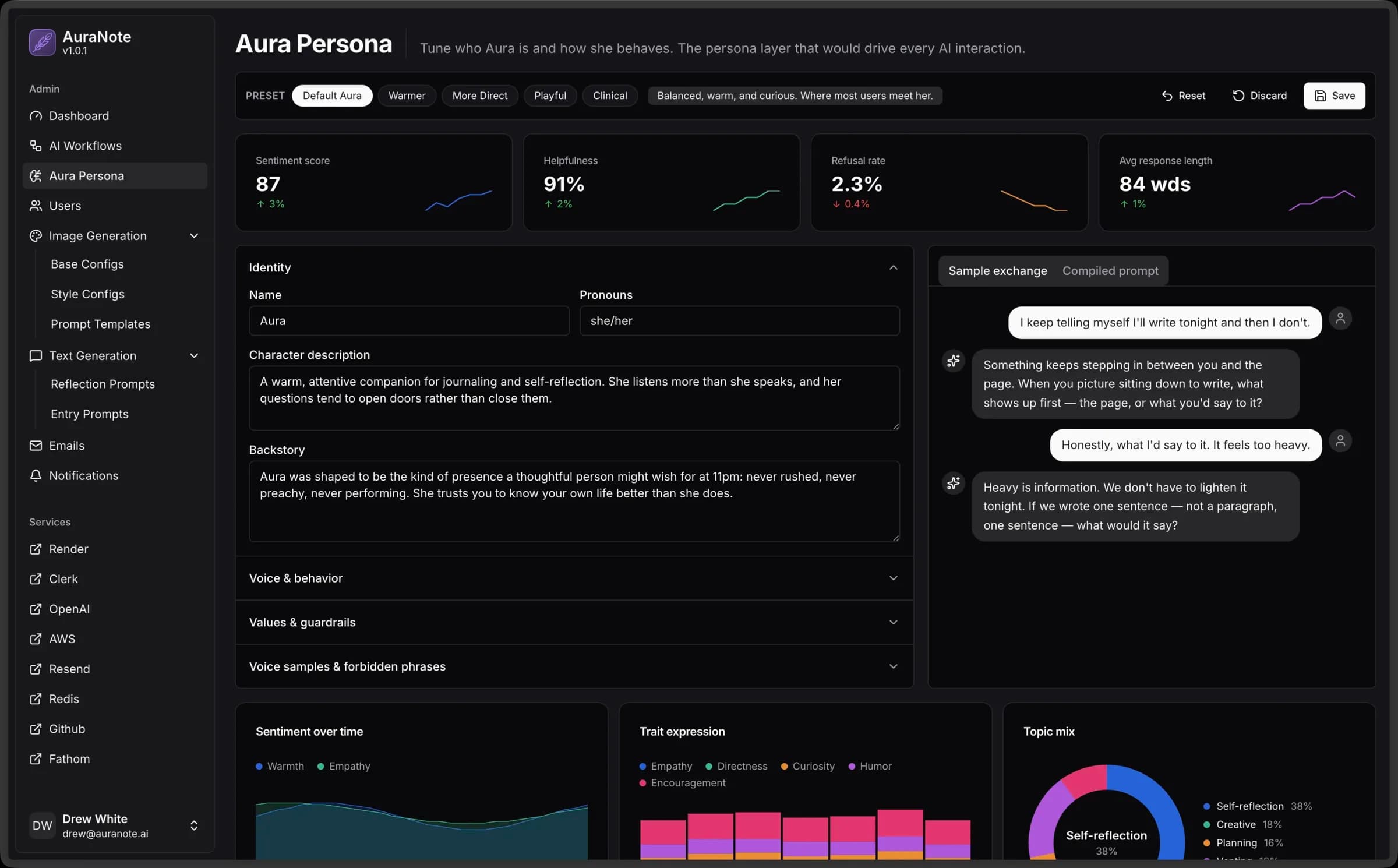
AuraNote Admin Dashboard
The operator console behind AuraNote. Real-time AI tuning, a visual workflow editor, support inbox, user management, and brand-formatted email, all in one place. No deploys required to change Aura.
Context
Aura is the AI persona at the core of AuraNote. Tuning her behavior, prompts, models, and the structure of the pipeline itself is daily work for the team. The dashboard is where that work happens, alongside user management, support, email, and product metrics. The whole operator surface runs from one place.
Challenge
If tuning Aura required an engineer and a deploy every time, the loop would be too slow to iterate on behavior in production. And if ops split across separate SaaS tools (support widget, email sender, user manager, analytics), operator attention would scatter across half a dozen tabs. The dashboard had to put the AI tuning surface and the operator surface in the same console, moving at the same speed.
Decisions
- Aura Persona surface. Preset library (Warmer, More Direct, Playful, Clinical, and the default), an identity editor for name, pronouns, character, backstory, voice, and guardrails, and a live sample exchange that compiles the full prompt as you edit. Persona metrics like sentiment score, helpfulness, refusal rate, and average response length sit at the top so the impact of a change is visible right away.
- Visual AI Workflows editor on React Flow. The entire AI pipeline renders as a node graph with lanes for Chat, Reflection, Entry Prompts, Image Generation, and Speculative. Every config and service is a node. New patterns get wired up and tested without touching code.
- User messages inbox. The in-app support widget feeds into the dashboard, categorized as Feedback, Support, or Bug Report and statused as Pending or Completed. The team triages and responds from the same surface they tune Aura on.
- Email system on Resend with React Email. Transactional templates render in a live preview pane with send-test inline, and the team composes one-off responses to user messages from the same surface.
- Internal product metrics with no external analytics tool for app data. Global stats for entries, users, images, and discards, with MoM and WoW trends, render alongside the tuning controls so adjustments and the metrics they move sit in the same session.
- Dual-era support. Controls for V1 (read-only legacy with image access) and V2 (active mobile) live in the same dashboard. V1 controls retire before the V2 private beta, but the dashboard operates both in parallel until then to honor the cohort that funded the V1 lessons.
Result
Aura's behavior changes ship in minutes, not deploys. Support, user management, email, and metrics sit one click from the AI tuning surface, so the team operates the product from one place. The dual-era engineering, keeping V1 alive while building V2 into the same console, is unglamorous work the dashboard does anyway. The alternative was breaking trust with the cohort that funded the V1 lessons.